
Unraveling Quantum Computing's Holy Grail: Topological Qubits Explained for Ultimate Fault Tolerance
Dive deep into the fascinating world of quantum computing as we explore one of its most promising and intriguing frontiers: topological qubits. In the quest to build truly scalable and powerful quantum computers, overcoming the inherent fragility of quantum information is paramount. This comprehensive guide will explain how topological qubits offer a revolutionary approach to achieving intrinsic fault tolerance, potentially unlocking the full potential of quantum technology. Understanding their unique properties, from the exotic physics of Majorana fermions to the elegant concept of braiding, is key to grasping the future of robust quantum computation.
The Fundamental Challenge: Quantum Errors and Decoherence
At the heart of quantum computing lies the qubit, the quantum analogue of the classical bit. Unlike classical bits that are either 0 or 1, qubits can exist in a superposition of both states simultaneously, allowing for exponentially more complex calculations. However, this very power is also their greatest vulnerability. Qubits are incredibly delicate and susceptible to interference from their environment, a phenomenon known as decoherence.
Even the slightest interaction with external noise – stray electromagnetic fields, temperature fluctuations, or vibrations – can cause a qubit's quantum state to collapse, leading to errors. For conventional qubits, such as those based on superconducting circuits or trapped ions, maintaining quantum coherence for long enough to perform complex computations is an immense challenge. As quantum systems grow larger and more complex, the rate of errors increases dramatically, making accurate computation nearly impossible without sophisticated quantum error correction mechanisms. While traditional error correction codes are vital, they require a significant overhead of additional qubits and complex control systems, making scalability a formidable hurdle.
Why Traditional Qubits Are Inherently Fragile
- Environmental Sensitivity: Conventional qubits encode information in local physical properties (e.g., electron spin, charge state). These local properties are highly sensitive to environmental noise.
- Short Coherence Times: The time a qubit can maintain its quantum state before decohering is often measured in microseconds, far too short for complex algorithms.
- High Error Rates: Even with advanced techniques, error rates in current quantum computers are still too high for practical, large-scale applications.
- Scalability Challenges: Implementing robust quantum error correction for millions of qubits, as needed for practical applications, is an engineering nightmare due to the immense resource overhead.
Enter Topological Qubits: A Paradigm Shift in Quantum Computing
This is where topological qubits emerge as a potential game-changer. Instead of encoding information in fragile local properties, topological qubits leverage the inherent properties of certain exotic materials and the global arrangement of their constituent particles. This approach offers a fundamentally different pathway to achieving fault tolerance, providing a level of robustness unmatched by conventional qubit architectures.
The concept of topological quantum computation was first proposed by Alexei Kitaev and later championed by researchers like Michael Freedman and Chetan Nayak. It draws inspiration from topology, a branch of mathematics concerned with properties of geometric objects that are preserved under continuous deformations. Imagine a donut and a coffee cup; topologically, they are the same because one can be continuously transformed into the other without tearing or gluing. This concept of invariance against local deformation is precisely what gives topological qubits their remarkable stability.
What Makes Them "Topological"? Understanding the Underlying Physics
The "topological" nature of these qubits stems from how they store quantum information. Rather than being stored on individual particles, the information is encoded in the collective, non-local properties of a system. Specifically, it's about the "braiding" patterns of exotic quasi-particles called non-abelian anyons.
The Enigma of Majorana Fermions
The most prominent candidates for realizing topological qubits are based on Majorana fermions, or more accurately, Majorana zero modes. These are peculiar particles that are their own antiparticles. While free Majorana fermions are elusive, they are predicted to emerge as quasi-particles at the ends of certain one-dimensional topological superconductors or at the interfaces of specific topological insulator materials. They don't carry charge or spin in the conventional sense, but their existence is a consequence of the underlying topological state of matter.
What makes Majorana zero modes so special for quantum computing? Critically, they are non-abelian anyons. Unlike "abelian" particles (like electrons) where swapping two particles always results in the same quantum state, swapping two non-abelian anyons can change the overall quantum state of the system in a non-trivial way. This change depends on the order in which the particles are swapped – a property known as non-abelian statistics.
The Power of Braiding: Intrinsic Fault Tolerance
The magic of topological qubits lies in how quantum information is manipulated and stored: through a process called braiding. Imagine a system where multiple Majorana zero modes exist. When these Majorana zero modes are physically moved around each other – literally braided like strands of hair – their collective quantum state evolves. The final state of the system depends not on the precise path taken by each individual Majorana, but solely on the topological configuration of their braids.
This is the core of their intrinsic fault tolerance. Because the quantum information is encoded in the global, topological properties of the braid, it is naturally protected from local disturbances. A small jiggle or a bit of noise affecting one part of the system won't destroy the overall topological pattern, much like cutting a single strand of a tightly braided rope doesn't immediately unravel the entire structure. The information is delocalized and robust against local perturbations, making them far less susceptible to decoherence than conventional qubits.
Advantages of Topological Qubits for Scalable Quantum Computing
The pursuit of topological qubits is driven by several compelling advantages:
- Inherent Error Resistance: Their topological protection means they are naturally robust against local noise and imperfections, significantly reducing the need for extensive external quantum error correction hardware. This is a monumental step towards practical fault-tolerant quantum computing.
- Longer Coherence Times: By encoding information non-locally, the quantum state can persist for much longer periods, allowing for more complex computations.
- Reduced Hardware Complexity: While still challenging to fabricate, the promise of built-in error resilience could simplify the overall architecture of large-scale quantum computers compared to error-prone conventional designs.
- Scalability Potential: The robustness against noise makes scaling up the number of qubits more feasible, as the error rate doesn't necessarily skyrocket with increased qubit count. This directly addresses one of the biggest bottlenecks in current quantum hardware development.
- Fundamental Physics Insight: Research into topological qubits also pushes the boundaries of condensed matter physics, leading to discoveries about exotic states of matter.
Challenges and Hurdles in Realizing Topological Qubits
Despite their immense promise, the development of topological qubits faces significant scientific and engineering challenges:
- Creating Majorana Fermions: The biggest hurdle is reliably creating, detecting, and manipulating Majorana zero modes. They are not fundamental particles but rather emergent phenomena in specific materials under extreme conditions (e.g., near absolute zero temperature, strong magnetic fields).
- Material Science Limitations: Identifying and fabricating the ideal topological superconductor materials with the required properties is extremely difficult. Research is ongoing in materials like indium antimonide nanowires and hybrid superconductor-semiconductor systems.
- Experimental Verification: Proving the existence of Majorana zero modes and their non-abelian statistics unequivocally in an experimental setting has proven elusive, with many results being debated or difficult to reproduce.
- Complex Fabrication: Even if the materials are perfected, the precise engineering required to build devices capable of braiding these quasi-particles is incredibly intricate.
- Control and Measurement: Developing methods to precisely control the braiding operations and measure the final state without disturbing the delicate quantum information is a significant technological challenge.
Current Research and Future Prospects
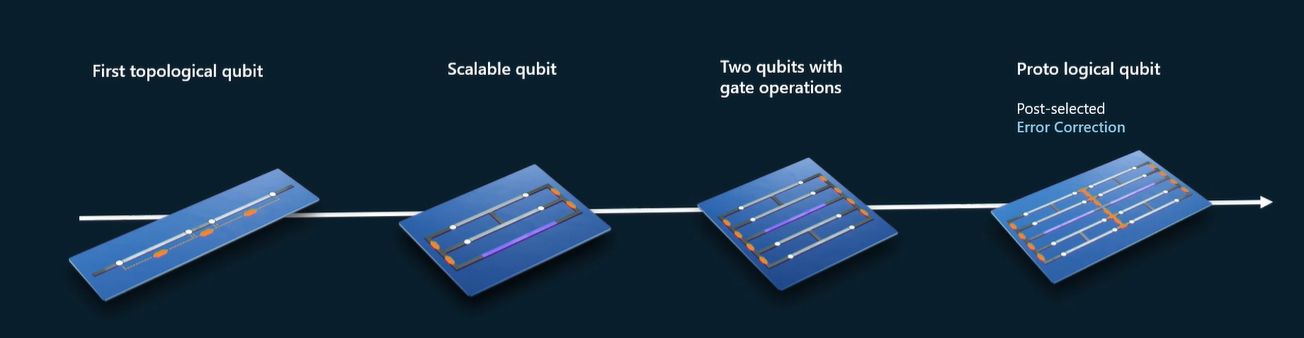
Leading research institutions and companies, notably Microsoft's Quantum program (Station Q), have invested heavily in the pursuit of topological qubits. Their approach focuses on creating hybrid semiconductor-superconductor nanowires designed to host Majorana zero modes. While significant progress has been made in fabricating these nanowires and observing signatures consistent with Majorana modes, definitive proof of their non-abelian statistics and the ability to perform braiding operations reliably remains an active area of research.
The journey to a fully functional topological quantum computer is a marathon, not a sprint. However, the potential rewards are immense. If successfully realized, these inherently fault-tolerant qubits could pave the way for true quantum advantage, allowing us to tackle problems currently intractable for even the most powerful supercomputers. This includes breakthroughs in drug discovery, materials science, cryptography, financial modeling, and artificial intelligence.
Actionable Insights for the Quantum Computing Enthusiast
For those keen on understanding the forefront of quantum technology, keeping an eye on the developments in topological qubits is crucial. Here are some tips:
- Follow Leading Research Groups: Keep up with publications from groups at universities like Delft, Copenhagen, and companies like Microsoft Quantum.
- Understand the Fundamentals: Grasping concepts like quantum mechanics, condensed matter physics, and basic topology will deepen your appreciation of the challenges and breakthroughs.
- Distinguish Qubit Architectures: Familiarize yourself with the pros and cons of different qubit types (superconducting, trapped ion, photonic, topological) to understand why topological approaches are so highly sought after for their inherent stability.
- Appreciate the Role of Error Correction: Recognize that all quantum computers will eventually need some form of error correction, but topological qubits promise to simplify this immensely.
- Look Beyond the Hype: While the promise is grand, the scientific and engineering challenges are real. Focus on concrete experimental progress rather than speculative timelines.
Frequently Asked Questions
What is the primary advantage of topological qubits over conventional qubits?
The primary advantage of topological qubits is their intrinsic fault tolerance. Unlike conventional qubits, which store information in local, fragile properties susceptible to environmental noise (decoherence), topological qubits encode information in the global, non-local properties of a system, specifically through the "braiding" patterns of exotic quasi-particles like Majorana fermions. This makes them inherently robust against local perturbations and significantly reduces the need for complex external quantum error correction, making them a strong candidate for scalable, reliable quantum computers.
Are Majorana fermions real and how are they used in topological qubits?
While fundamental Majorana fermions (particles that are their own antiparticles) are still hypothetical in free space, Majorana zero modes are predicted to exist as quasi-particles in specific condensed matter systems, such as the ends of topological superconductor nanowires or at certain material interfaces. These quasi-particles are not fundamental building blocks but emergent collective excitations. In topological qubits, quantum information is stored not on individual Majorana zero modes, but in the collective, non-local quantum state determined by the topological configuration of multiple such modes. Quantum operations are performed by physically "braiding" these modes around each other.
How does "braiding" encode quantum information?
Braiding is the fundamental operation in topological quantum computation. It involves physically moving non-abelian anyons (like Majorana zero modes) around each other in a specific sequence. Unlike conventional particles, the act of swapping two non-abelian anyons can change the overall quantum state of the system in a non-trivial way, depending on the order of the swaps. The quantum information is encoded in the resulting topological configuration of these braids, much like information can be stored in the knots of a rope. Because the information is encoded in the global pattern rather than local properties, it is protected from local noise and disturbances, providing inherent fault tolerance.
What are the biggest challenges facing the development of topological qubits?
The biggest challenges for topological qubits include the difficulty in reliably creating and experimentally verifying the existence of Majorana zero modes in engineered materials, as their signatures can be subtle and ambiguous. Material science hurdles in fabricating suitable topological superconductors with precise properties under extreme conditions (e.g., ultra-low temperatures) are also significant. Furthermore, developing the intricate control mechanisms to perform precise braiding operations and accurately measure the resulting quantum states without introducing errors remains a formidable technological and engineering challenge.
When can we expect to see practical topological quantum computers?
The development of practical topological quantum computers is still in its early research and development phase. While significant theoretical progress and some promising experimental results have emerged, overcoming the fundamental challenges related to material science, robust Majorana mode creation, and precise braiding operations will require substantial time and investment. Many experts believe that a truly fault-tolerant, scalable topological quantum computer is likely still a decade or more away, but the ongoing research in this field holds immense promise for the long-term future of quantum technology.

0 Komentar