
Quantum Computing for Graduate Students: Your Definitive Guide to Advanced Study & Research
Embarking on advanced studies in a rapidly evolving field like quantum computing for graduate students offers unparalleled opportunities to shape the future of technology. This comprehensive guide delves into the foundational concepts, cutting-edge research areas, and practical pathways for postgraduate students looking to make a significant impact in quantum information science. Discover how understanding principles like superposition and entanglement can unlock new computational paradigms, driving breakthroughs in everything from drug discovery to financial modeling. If you're a curious mind eager to push the boundaries of computational science, this article is your essential roadmap to navigating the exciting and challenging world of quantum computation.
The Quantum Leap: Why Graduate Students Should Pay Attention
The landscape of computing is undergoing a profound transformation, moving beyond the classical bits of zeros and ones to the probabilistic world of qubits. For graduate students, this shift represents not just an academic curiosity but a fertile ground for groundbreaking research and innovation. Quantum computing promises to tackle problems currently intractable for even the most powerful supercomputers, opening doors to solutions in areas like materials science, artificial intelligence, and cybersecurity. The interdisciplinary nature of this field, blending theoretical physics, computer science, mathematics, and engineering, makes it particularly appealing for post-graduate studies, offering a rich tapestry of challenges and discoveries.
Foundational Pillars: Essential Prerequisites for Quantum Computing
While the allure of quantum computing is strong, a solid academic foundation is crucial for graduate students aiming to excel. Success in this domain hinges on a robust understanding of several core disciplines:
- Linear Algebra: This is the mathematical language of quantum mechanics. A deep grasp of vector spaces, matrices, eigenvalues, and eigenvectors is indispensable for understanding qubit states, quantum gates, and circuit operations.
- Quantum Mechanics: Familiarity with the postulates of quantum mechanics, including wave functions, operators, and the Schrödinger equation, provides the physical intuition necessary to comprehend superposition, entanglement, and quantum measurement.
- Computer Science Fundamentals: Knowledge of algorithms, data structures, computational complexity, and basic programming (e.g., Python) is vital for developing and implementing quantum algorithms.
- Probability and Statistics: Given the probabilistic nature of quantum measurements, a strong background in these areas helps in interpreting results and understanding quantum error correction.
- Differential Equations and Complex Analysis: These mathematical tools are often used in advanced theoretical studies of quantum systems and their dynamics.
Many universities offer specialized courses or introductory pathways for graduate students from diverse backgrounds, but strengthening these core areas beforehand will significantly accelerate your progress in quantum studies. Consider exploring online courses or review texts on (Internal Link: Quantum Mechanics for Computer Science Students) to bridge any knowledge gaps.
Core Concepts of Quantum Computing for Advanced Study
At the heart of quantum computing lie principles that fundamentally differ from classical computation. Understanding these concepts is paramount for any graduate student venturing into this field.
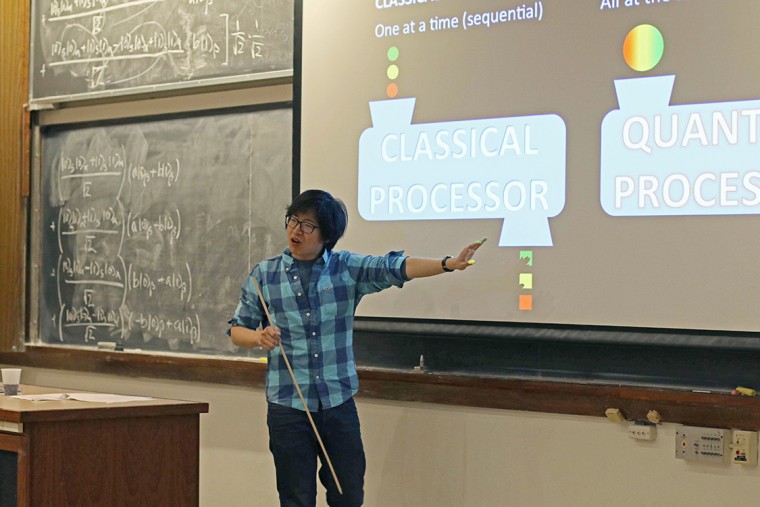
Unlike classical bits that exist in one of two states (0 or 1), qubits can exist in a superposition of both states simultaneously. This means a single qubit can represent a combination of 0 and 1 at the same time. The power truly amplifies with entanglement, a phenomenon where two or more qubits become intrinsically linked, such that the state of one instantly influences the state of the others, regardless of distance. This non-local correlation is a key resource for many powerful quantum algorithms and enables exponential speedups over classical methods for certain problems.
Quantum Algorithms: Beyond Classical Limits
The true promise of quantum computing lies in its ability to execute algorithms that are classically impossible or prohibitively slow. For graduate students, delving into the design and analysis of these algorithms is a primary research avenue. Key examples include:
- Shor's Algorithm: A polynomial-time algorithm for integer factorization, which has profound implications for modern cryptography. Its existence highlights the potential vulnerability of current encryption standards to large-scale quantum computers.
- Grover's Algorithm: Offers a quadratic speedup for searching unsorted databases, reducing the number of queries significantly compared to classical approaches.
- Quantum Simulation: One of the most promising applications, allowing the simulation of complex quantum systems (e.g., molecules, materials) with unprecedented accuracy. This has direct applications in drug discovery, materials science, and fundamental physics.
- Quantum Machine Learning (QML): Explores how quantum phenomena can enhance machine learning tasks, potentially leading to faster training times or improved model performance for complex datasets.
- Variational Quantum Eigensolver (VQE): A hybrid quantum-classical algorithm used for finding the ground state energy of molecules, crucial for chemistry and materials science.
Studying these algorithms involves understanding their underlying mathematical structures, their computational complexity, and their potential applications. Graduate students often specialize in adapting these algorithms for specific problems or designing entirely new ones.
Quantum Hardware and Software Ecosystems
The theoretical advancements in quantum computing are paralleled by rapid developments in quantum hardware and software. Graduate students interested in experimental physics or engineering can focus on the physical realization of qubits, while those inclined towards software can explore quantum programming environments.
Various physical platforms are being explored for building quantum computers:
- Superconducting Qubits: Utilized by IBM and Google, these qubits are macroscopic circuits cooled to extremely low temperatures.
- Trapped Ions: Employed by IonQ and Honeywell, these use electromagnetic fields to suspend individual ions, which act as qubits.
- Photonic Qubits: Based on photons as carriers of quantum information, explored by companies like Xanadu and PsiQuantum.
- Topological Qubits: A more theoretical approach, aiming for highly stable qubits resistant to decoherence.
On the software front, a robust ecosystem of quantum programming languages and SDKs has emerged, enabling researchers to write and test quantum algorithms:
- Qiskit (IBM): A popular open-source SDK for working with quantum computers at the level of circuits, algorithms, and applications.
- Cirq (Google): A Python framework for creating, editing, and invoking quantum circuits.
- PennyLane (Xanadu): A library for quantum machine learning and differentiable quantum programming.
Gaining hands-on experience with these tools is invaluable for graduate students, allowing them to translate theoretical concepts into practical experiments and simulations.
Navigating Research Opportunities and Specializations
For graduate students, identifying and engaging with relevant research opportunities is paramount. The field of quantum computing is vast, offering numerous specialization pathways within academic institutions, government labs, and private industry.
Key Research Areas for Graduate Students
The following are some of the most active and promising research areas for post-graduate studies in quantum computing:
- Quantum Error Correction: Developing methods to mitigate the effects of noise and decoherence on qubits, which is critical for building fault-tolerant quantum computers. This involves complex coding theory and advanced theoretical physics.
- Quantum Cryptography: Researching quantum-safe cryptographic protocols, such as Quantum Key Distribution (QKD), and analyzing the security implications of quantum algorithms for existing cryptographic systems.
- Quantum Machine Learning: Exploring the intersection of quantum mechanics and machine learning, including quantum algorithms for data analysis, optimization, and pattern recognition.
- Quantum Simulation: Designing and implementing quantum algorithms to simulate complex physical and chemical systems, with applications in materials science, drug discovery, and fundamental physics.
- Quantum Annealing: Investigating specialized quantum computing paradigms for optimization problems, often used in logistics, financial modeling, and AI.
- Quantum Algorithm Design: Creating novel quantum algorithms for specific problems that offer exponential or polynomial speedups over classical counterparts. This often involves deep theoretical insights and mathematical rigor.
- Quantum Hardware Engineering: Focusing on the physical construction and improvement of quantum devices, including qubit fabrication, control systems, and cryogenic engineering.
- Quantum Networking: Developing the infrastructure for quantum communication, enabling secure data transfer and distributed quantum computing.
Many institutions offer specialized graduate programs or research groups dedicated to these areas. Exploring faculty research interests and published papers is an excellent way to find a suitable match for your academic pursuits.
Practical Steps for Engagement
As a graduate student, proactive engagement is key to building your expertise and network in quantum computing:
- Join Research Groups: Seek out professors and research labs at your university (or others) that are active in quantum computing. Even if your primary degree isn't in quantum physics, an interdisciplinary approach is highly valued.
- Attend Seminars and Workshops: Participate in university seminars, online workshops, and conferences focused on quantum information science. This is crucial for staying updated on the latest breakthroughs and networking with leading experts.
- Take Specialized Courses: Enroll in advanced courses on quantum mechanics, quantum information theory, quantum algorithms, and computational physics.
- Engage with Open-Source Projects: Contribute to or utilize open-source quantum software platforms like Qiskit, Cirq, or PennyLane. This hands-on experience is invaluable for practical skill development.
- Pursue Internships: Look for internship opportunities at quantum computing companies (e.g., IBM Quantum, Google AI Quantum, IonQ, D-Wave) or government research labs. These provide real-world experience and potential career pathways.
For a deeper dive into available resources, consider visiting (Internal Link: Comprehensive Resources for Quantum Computing Graduates).
Career Trajectories in the Quantum Realm
A specialization in quantum computing for graduate students opens doors to a diverse array of highly sought-after career paths. As the field matures, demand for experts with deep knowledge in quantum information science is rapidly increasing across various sectors.
Diverse Roles for Quantum Graduates
Graduates with expertise in quantum computing can pursue roles in:
- Quantum Software Engineer: Developing quantum algorithms, programming quantum computers, and building quantum software tools. This often involves working with quantum SDKs and cloud-based quantum platforms.
- Quantum Research Scientist: Conducting fundamental and applied research in academia, government labs, or industrial R&D departments. This role involves designing experiments, developing new theories, and publishing findings.
- Quantum Algorithm Developer: Specializing in the creation and optimization of algorithms for specific applications, such as quantum simulation for drug discovery or quantum optimization for financial services.
- Quantum Hardware Engineer: Focusing on the design, fabrication, and testing of quantum processors and supporting infrastructure. This role requires strong backgrounds in electrical engineering, materials science, or experimental physics.
- Quantum Cryptographer/Security Analyst: Working on post-quantum cryptography, developing quantum-safe encryption methods, and assessing the security of current cryptographic systems against quantum attacks.
- Consultant/Strategist: Advising businesses and governments on the potential impact of quantum computing, developing quantum strategies, and identifying opportunities for adoption.
- Data Scientist/Machine Learning Engineer (Quantum-Enhanced): Applying quantum principles to enhance classical data science and machine learning tasks, focusing on QML models and quantum-inspired algorithms.
The interdisciplinary nature of quantum computing means that graduates are well-equipped to bridge the gap between theoretical physics and practical engineering, making them invaluable assets in the evolving tech landscape. For more detailed career insights, explore (Internal Link: Your Quantum Computing Career Guide).
Challenges and the Road Ahead
Despite its immense promise, quantum computing is still in its nascent stages, facing significant challenges that present further research opportunities for graduate students. The primary hurdles include decoherence (the loss of quantum properties due to interaction with the environment), scalability (building quantum computers with a large number of stable qubits), and error correction (making quantum computations fault-tolerant).
Addressing these challenges requires sustained innovation in both hardware and software, demanding a new generation of scientists and engineers. The pursuit of quantum supremacy – demonstrating a quantum computer can solve a problem that no classical computer can in a feasible amount of time – continues to drive intense research and development. For graduate students, this means contributing to the fundamental science and engineering that will ultimately lead to widespread practical quantum applications.
The Future of Quantum Computing Education
As the field progresses, so too must the educational frameworks. Universities are increasingly developing specialized graduate programs, certificates, and research centers dedicated to quantum information science. These programs emphasize not only theoretical understanding but also practical, hands-on experience with quantum programming tools and access to quantum hardware. The future of quantum computing for graduate students lies in fostering an environment of continuous learning, rigorous research, and strong interdisciplinary collaboration to overcome the remaining barriers and unlock the full potential of this transformative technology.
Frequently Asked Questions
What foundational knowledge is essential for quantum computing for graduate students?
For graduate students interested in quantum computing, a strong foundation in linear algebra, quantum mechanics, and fundamental computer science (including algorithms and data structures) is essential. Proficiency in probability and statistics, along with a basic understanding of programming languages like Python, will also significantly aid your studies and research in this complex field.
What are the primary research areas in quantum computing for post-graduate studies?
Post-graduate studies in quantum computing often focus on cutting-edge areas such as quantum error correction, the design of novel quantum algorithms (e.g., for quantum simulation or quantum machine learning), research into various quantum hardware platforms (superconducting, trapped ion, photonic), and the development of quantum cryptography and networking solutions. These areas offer vast opportunities for significant academic and industrial contributions.
How can graduate students gain practical experience in quantum programming?
Graduate students can gain practical experience in quantum programming by utilizing open-source SDKs like IBM's Qiskit, Google's Cirq, or Xanadu's PennyLane. These platforms allow you to write, simulate, and even run quantum circuits on real quantum hardware via cloud access. Additionally, participating in online quantum challenges, contributing to open-source quantum projects, and seeking internships with quantum technology companies provide invaluable hands-on experience.
What career paths are available for someone specializing in quantum computing after graduate school?
A specialization in quantum computing for graduate students opens up diverse and high-demand career paths. Graduates can become quantum software engineers, quantum research scientists in academia or industry, quantum algorithm developers, quantum hardware engineers, or experts in quantum cryptography. Roles also exist in consulting, data science, and even entrepreneurship, leveraging their deep understanding of advanced computing paradigms.
What are the biggest challenges and opportunities in the field?
The biggest challenges in quantum computing currently include overcoming decoherence, scaling quantum systems to a large number of stable qubits, and implementing effective quantum error correction. However, these challenges also present immense opportunities for graduate students to contribute to groundbreaking research. The opportunity lies in developing fault-tolerant quantum computers, creating novel quantum algorithms for currently intractable problems, and exploring new applications in medicine, materials science, and artificial intelligence, ultimately leading to transformative technological advancements.

0 Komentar