
5G Edge Computing Benefits for Autonomous Vehicles: Powering the Future of Mobility
The dawn of fully autonomous vehicles is not just a futuristic vision; it's a rapidly approaching reality, fundamentally reshaped by the convergence of two transformative technologies: 5G and edge computing. This powerful synergy is unlocking unprecedented capabilities, directly addressing the complex challenges of real-time processing, data management, and safety critical operations inherent in self-driving cars. Understanding the profound 5G edge computing benefits for autonomous vehicles is crucial for anyone navigating the evolving landscape of intelligent transportation. From ultra-low latency communication to enhanced data sovereignty, edge computing, powered by 5G, is the invisible engine driving the next generation of mobility, ensuring vehicles can make instantaneous, life-saving decisions while optimizing performance and efficiency.
The Indispensable Role of Edge Computing in Autonomous Driving
Autonomous vehicles generate an astonishing amount of data – terabytes per hour from an array of sensors including LiDAR, cameras, radar, and ultrasonic devices. Processing this colossal data stream for immediate decision-making, such as obstacle detection, lane keeping, and navigation, demands computational power far beyond what traditional onboard systems or distant cloud data centers can reliably provide. This is precisely where edge computing steps in, bringing computation and data storage closer to the source of data generation – the vehicle itself or nearby network infrastructure. Coupled with 5G's unparalleled speed and low latency, edge computing becomes the critical enabler for true autonomy, moving beyond mere connectivity to enabling genuine intelligence at the very edge of the network.
Ultra-Low Latency for Instantaneous Decision-Making
- Criticality of Latency: In the realm of autonomous driving, milliseconds matter. A delay of even a few hundredths of a second can be the difference between avoiding an accident and a catastrophic collision. Traditional cloud computing, despite its power, introduces latency due to the round-trip distance data must travel to a centralized data center and back.
- 5G's Role: 5G networks boast theoretical latencies as low as 1 millisecond (ms), a significant leap from 4G's 50-100ms. When combined with edge computing, this translates into near-instantaneous communication between vehicles, infrastructure, and the localized processing units.
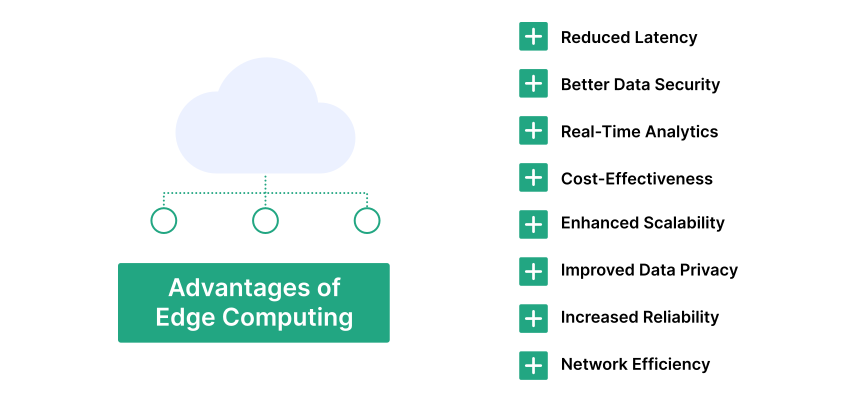
- Real-Time Responsiveness: This ultra-low latency facilitates real-time data processing, allowing autonomous vehicles to react to dynamic road conditions, pedestrian movements, and sudden events with human-like, or even superhuman, speed. Features like automatic emergency braking, evasive maneuvers, and precise vehicle platooning become far more reliable.
Enhanced Data Processing and Analytics at the Edge
The sheer volume of data produced by autonomous vehicles necessitates a distributed processing approach. While some critical functions are handled by powerful onboard computers, offloading non-critical but still vital data analysis to the edge offers significant advantages.
- Massive Data Ingestion: Autonomous vehicles continuously ingest data from multiple sensors. Processing all of this on a vehicle's local hardware can be energy-intensive and computationally demanding.
- Edge AI Capabilities: Edge servers equipped with powerful GPUs can run complex edge AI algorithms and machine learning models for tasks like advanced object recognition, traffic pattern prediction, and route optimization. This allows for rapid insights without sending all raw data to the distant cloud.
- Contextual Understanding: By processing data locally, vehicles gain a richer, more immediate contextual understanding of their surroundings. This includes aggregating data from other connected vehicles and smart city infrastructure (traffic lights, road sensors) in real-time, enhancing situational awareness significantly.
- Predictive Analytics: Edge computing enables localized predictive analytics, allowing vehicles to anticipate potential hazards or traffic congestion based on immediate environmental data, rather than relying solely on pre-mapped information or delayed cloud updates.
Superior Reliability and Redundancy for Critical Operations
Autonomous vehicles operate in dynamic, unpredictable environments where connectivity cannot be compromised. Edge computing, underpinned by 5G, significantly enhances the reliability and resilience of autonomous systems.
- Reduced Dependence on Central Cloud: By performing critical computations at the edge, autonomous vehicles become less reliant on a constant, high-bandwidth connection to a central cloud data center. This reduces the risk of service interruption due to network congestion or outages.
- Local Redundancy: Edge nodes can provide localized redundancy, ensuring that if one communication path or processing unit fails, another nearby can take over seamlessly. This is vital for safety-critical applications.
- Network Slicing: 5G's inherent capability for network slicing allows telecommunication providers to create dedicated, isolated virtual networks with guaranteed performance characteristics (e.g., ultra-low latency, high bandwidth) specifically for autonomous vehicle communication. This ensures priority and consistent quality of service, even in congested areas.
Optimized Bandwidth Utilization and Cost Efficiency
Sending all raw sensor data from thousands or millions of autonomous vehicles to central cloud data centers would overwhelm existing network infrastructure and incur massive operational costs. Edge computing mitigates this challenge.
- Data Filtering at Source: Only processed, aggregated, or critical data needs to be sent to the centralized cloud for long-term storage, analytics, or machine learning model training. The vast majority of raw, time-sensitive data is processed and acted upon at the edge.
- Reduced Backhaul Traffic: This intelligent filtering significantly reduces the amount of data transmitted over the core network (backhaul), freeing up bandwidth for other services and lowering operational expenses for network operators and autonomous vehicle developers alike.
- Cost Savings for Fleet Management: For large autonomous vehicle fleets, reduced data transmission costs and more efficient resource utilization translate into substantial long-term savings. This model also supports more economical deployment of services like ride-sharing or logistics.
Fortified Security and Data Sovereignty
Data security and privacy are paramount concerns for autonomous vehicles, handling sensitive location data, passenger information, and critical operational data. Edge computing offers inherent advantages in these areas.
- Reduced Attack Surface: By processing data closer to its origin and minimizing its transit over public networks, edge computing reduces the potential attack surface for cyber threats. Data is less exposed to interception or tampering during long-distance transmission.
- Localized Data Control: Edge deployments can facilitate better adherence to regional data sovereignty and privacy regulations (like GDPR). Data can be processed and stored within specific geographical boundaries, simplifying compliance.
- Enhanced Anomaly Detection: Localized processing enables faster detection of anomalies or potential cyber threats within a specific operational zone, allowing for quicker response and mitigation.
Scalability and Flexibility for Evolving Autonomous Fleets
The transition to widespread autonomous vehicle adoption will be gradual, involving various levels of autonomy and diverse operational environments. 5G edge computing provides the necessary scalability and flexibility.
- Modular Deployment: Edge infrastructure can be deployed incrementally, scaling up as autonomous vehicle adoption grows in specific areas or corridors. This allows for targeted investment and efficient resource allocation.
- Support for Diverse Use Cases: From last-mile delivery robots to heavy-duty autonomous trucks and public transit, 5G edge computing can be tailored to meet the specific latency, bandwidth, and processing requirements of different autonomous vehicle applications.
- Seamless Updates and Upgrades: Edge nodes can facilitate over-the-air (OTA) software updates and AI model improvements for autonomous vehicles more efficiently, distributing updates locally rather than relying solely on broad cloud distribution.
Technical Synergy: How 5G and Edge Computing Intertwine
The benefits described above are not achieved by 5G or edge computing in isolation, but through their deep technical integration. This synergy is what truly unlocks the potential for advanced autonomous driving systems.
Multi-access Edge Computing (MEC) Explained
At the heart of this synergy is Multi-access Edge Computing (MEC), an ETSI standard that defines how computing capabilities can be embedded within the mobile network's access edge. MEC servers are typically located at cell towers, local data centers, or even within base stations, bringing computational resources significantly closer to the end-user device – in this case, the autonomous vehicle.
MEC enables network operators to offer specialized services directly at the edge, bypassing the need to route all traffic to a central cloud. This is crucial for applications demanding ultra-low latency, such as vehicle-to-everything (V2X) communication, real-time traffic management, and high-definition mapping updates.
Vehicle-to-Everything (V2X) Communication Unleashed
V2X communication is a cornerstone of autonomous driving, allowing vehicles to communicate with other vehicles (V2V), infrastructure (V2I), pedestrians (V2P), and the network (V2N). 5G provides the high-bandwidth, low-latency pipes, while edge computing provides the local processing power to make V2X truly effective.
For instance, a vehicle can receive immediate alerts about an accident around a blind corner from another vehicle (V2V) or a smart traffic light (V2I) via an edge server, process that information locally, and adjust its speed or route almost instantaneously. This enhances situational awareness far beyond what a vehicle's onboard sensors alone can provide. Explore more about V2X communication and its transformative impact.
The Power of Distributed Sensor Fusion
Autonomous vehicles rely on sensor fusion – combining data from multiple types of sensors (LiDAR, radar, cameras, GPS) to create a comprehensive, robust understanding of their environment. While much of this occurs onboard, edge computing extends this capability to a distributed model.
Edge servers can aggregate and fuse data from multiple vehicles in a convoy, or from vehicles and roadside units, providing a wider, more accurate, and redundant perception of the environment. This distributed sensor fusion improves the reliability of perception, especially in challenging conditions like heavy rain or fog, where individual sensors might be compromised.
Practical Implications for Autonomous Vehicle Development
For OEMs, technology providers, and urban planners, leveraging 5G edge computing is not just an option but a strategic imperative. Here are actionable tips for integrating these technologies:
- Prioritize Edge-Native Architecture: Design autonomous vehicle software and systems with edge processing in mind. Identify which functions are latency-critical and best suited for edge deployment versus onboard or cloud processing.
- Invest in 5G-Enabled Hardware: Ensure future autonomous vehicle models are equipped with 5G modems and communication modules capable of utilizing 5G's full capabilities, including network slicing and ultra-reliable low-latency communication (URLLC).
- Collaborate on Standards: Actively participate in industry consortia and standardization bodies (e.g., 3GPP, ETSI, SAE) to help shape the future of 5G edge for autonomous vehicles, ensuring interoperability and security across the ecosystem.
- Develop Robust Edge AI Models: Focus on creating lightweight yet powerful AI models that can run efficiently on edge hardware, capable of real-time inference for critical tasks like object detection and path planning.
- Focus on Cybersecurity from Day One: Implement robust security measures at every layer of the edge computing stack, from hardware security modules on edge devices to secure communication protocols and stringent access controls.
Frequently Asked Questions About 5G Edge Computing for Autonomous Vehicles
What is the primary benefit of 5G edge computing for autonomous vehicles?
The primary benefit is enabling ultra-low latency communication and real-time data processing. This allows autonomous vehicles to make instantaneous, safety-critical decisions, such as emergency braking or evasive maneuvers, by processing sensor data and communicating with other vehicles or infrastructure with minimal delay, often within milliseconds.
How does edge computing enhance the safety of self-driving cars?
Edge computing significantly enhances safety by providing faster reaction times due to localized processing, improving situational awareness through real-time aggregation of data from multiple sources (V2X communication), and offering greater network reliability and redundancy. This distributed intelligence reduces dependence on distant cloud servers, mitigating risks associated with network outages or high latency.
Can 5G edge computing completely replace onboard processing in autonomous vehicles?
No, 5G edge computing is designed to complement, not entirely replace, onboard processing. Autonomous vehicles will always require robust onboard computers for immediate, mission-critical functions that cannot tolerate any external network dependency. Edge computing offloads less time-critical but still vital data analysis and provides an additional layer of intelligence and redundancy, forming a powerful hybrid processing architecture.
What role does Multi-access Edge Computing (MEC) play in autonomous driving?
Multi-access Edge Computing (MEC) brings computational resources and application services closer to the autonomous vehicles, typically at the cellular base station or local data center. This drastically reduces data travel distance, enabling the ultra-low latency and high bandwidth required for real-time V2X communication, distributed sensor fusion, and rapid execution of edge AI models, which are crucial for safe and efficient autonomous operations.
What are the security advantages of using edge computing for autonomous vehicles?
Edge computing offers several security advantages for autonomous vehicles. By processing data closer to the source, it reduces the amount of sensitive data transmitted over long distances across the public internet, thereby minimizing the attack surface. It also facilitates adherence to data sovereignty regulations by keeping data processing and storage localized. Furthermore, edge nodes can enable faster detection and response to localized cyber threats or anomalies.
Ready to accelerate your autonomous vehicle development with cutting-edge 5G edge solutions? Contact our experts today to explore how our specialized services can empower your innovation in smart mobility.

0 Komentar