
Revolutionizing Mobility: IoT Platforms for Smart Transportation Solutions
The landscape of urban and inter-city movement is undergoing a profound transformation, driven by the relentless march of digital innovation. At the heart of this evolution lies the strategic deployment of IoT platforms for building IoT solutions for smart transportation. These sophisticated digital ecosystems are not merely tools; they are the foundational backbone enabling the creation of intelligent, efficient, and sustainable mobility systems. From optimizing complex logistics operations to enhancing public transit efficiency and safeguarding autonomous vehicle deployments, a robust IoT platform is indispensable. This comprehensive guide delves into the critical role these platforms play, exploring their core functionalities, practical applications, and the essential considerations for selecting the right one to propel the future of smart transportation.
The Imperative for Smart Transportation Evolution
Our cities are becoming increasingly crowded, and the demands on transportation infrastructure are escalating. Traditional methods of managing traffic, fleets, and public transport are often reactive, inefficient, and struggle to keep pace with modern challenges. This is where smart transportation, powered by the Internet of Things, steps in. It promises a future where vehicles, infrastructure, and commuters are interconnected, sharing real-time data to create a seamless, safer, and more environmentally friendly experience.
Current Challenges in Urban Mobility and Logistics
Modern transportation systems face a multitude of hurdles:
- Traffic Congestion: Leading to lost productivity, increased fuel consumption, and higher emissions.
- Inefficient Fleet Operations: Suboptimal routing, poor vehicle utilization, and lack of predictive maintenance capabilities result in higher operational costs.
- Public Transit Deficiencies: Lack of real-time information for commuters, unpredictable schedules, and challenges in managing diverse fleets.
- Environmental Impact: High carbon footprints from fossil-fuel-dependent vehicles.
- Safety Concerns: Accidents, theft, and security vulnerabilities across the transportation network.
- Data Silos: Disconnected systems preventing holistic insights and integrated decision-making.
Addressing these challenges effectively requires a converged approach, integrating diverse data streams from vehicles, infrastructure, and users. This is precisely the domain where specialized IoT platforms prove their worth, acting as the central nervous system for complex transportation ecosystems.
What Are IoT Platforms and Why Are They Crucial for Smart Transportation?
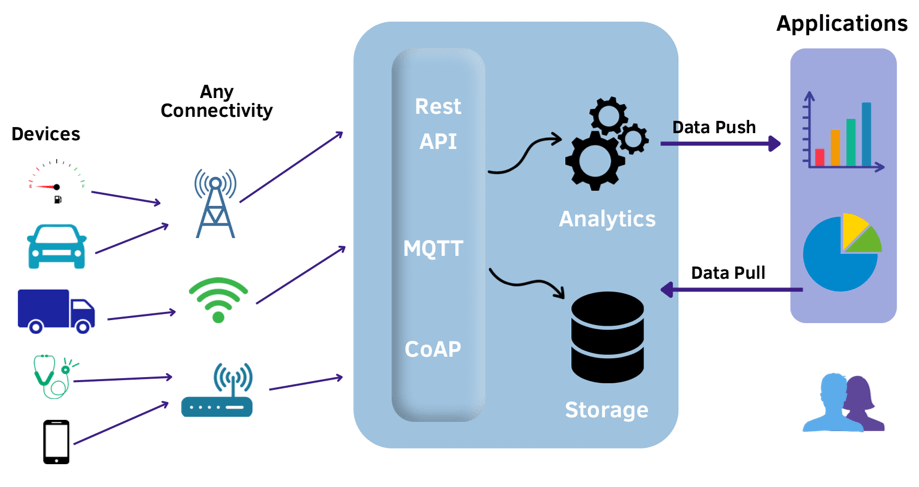
An IoT platform serves as middleware, bridging the gap between physical IoT devices (sensors, cameras, GPS units on vehicles, traffic lights) and the applications that consume and act upon the data these devices generate. For smart transportation, these platforms provide the necessary infrastructure to connect, manage, and analyze vast quantities of data from moving assets and static infrastructure, transforming raw information into actionable insights.
Core Components of a Robust IoT Platform for Transportation
A comprehensive IoT platform tailored for smart transportation solutions typically comprises several critical components:
- Device Connectivity & Management: Facilitates seamless connection of diverse devices (OBD-II dongles, GPS trackers, environmental sensors, cameras) over various protocols (cellular, Wi-Fi, Bluetooth, LPWAN). It also handles device onboarding, configuration, monitoring, and firmware updates.
- Data Ingestion & Processing: Efficiently collects, filters, and processes massive volumes of sensor data from vehicles and infrastructure in real-time. This includes handling data normalization, transformation, and initial analysis at scale.
- Data Storage & Analytics: Provides secure and scalable storage for historical and real-time data. Advanced analytics modules, including machine learning capabilities, are crucial for identifying patterns, predicting outcomes (e.g., equipment failure, traffic bottlenecks), and generating actionable insights.
- Application Enablement & APIs: Offers tools and APIs (Application Programming Interfaces) that allow developers to build specific transportation applications (e.g., fleet management dashboards, passenger information systems, traffic optimization tools) on top of the platform.
- Security & Identity Management: Ensures the integrity and confidentiality of data from device to cloud. This includes device authentication, data encryption, access control, and robust cybersecurity measures against potential threats.
- Integration Capabilities: Seamlessly integrates with existing enterprise systems like ERP, CRM, telematics systems, and GIS mapping tools, preventing data silos and fostering a holistic view of operations.
- Scalability & Reliability: Must be able to handle an ever-growing number of connected devices and increasing data volumes without performance degradation, ensuring continuous operation for mission-critical transportation services.
Without such a unified platform, building and maintaining complex IoT solutions for transportation would be fragmented, costly, and extremely difficult to scale. It's the central nervous system that orchestrates all the moving parts.
Practical Applications of IoT Platforms in Smart Transportation
The versatility of IoT platforms empowers a wide array of transformative applications across the transportation sector. These applications leverage real-time data and advanced analytics to enhance efficiency, safety, and user experience.
Enhancing Fleet Management and Logistics
For logistics companies and commercial fleets, IoT platforms are game-changers. They provide a comprehensive overview of fleet operations, leading to significant cost savings and improved service delivery.
- Vehicle Tracking & Monitoring: Enables precise vehicle tracking (GPS location, speed, mileage) and monitoring of vehicle health (fuel levels, engine diagnostics) in real-time. This is crucial for optimizing routes and ensuring timely deliveries.
- Route Optimization: Dynamically adjusts routes based on live traffic conditions, weather, and delivery schedules, reducing travel time and fuel consumption.
- Predictive Maintenance: By analyzing sensor data from vehicle components, platforms can predict potential equipment failures before they occur, allowing for proactive maintenance and minimizing costly downtime. This is a significant factor in reducing operational expenses.
- Driver Behavior Monitoring: Tracks driving patterns (harsh braking, rapid acceleration) to promote safer driving habits, reduce accidents, and lower insurance premiums.
- Cold Chain Monitoring: For perishable goods, IoT sensors integrated with the platform monitor temperature and humidity within cargo, ensuring compliance and preventing spoilage.
Consider a large logistics company managing hundreds of trucks. An IoT platform allows them to visualize their entire fleet on a digital map, track individual shipments, receive alerts on deviations, and even generate reports on driver performance. This level of granular control was previously unimaginable without significant manual effort.
Revolutionizing Public Transit and Urban Mobility
IoT platforms are also instrumental in modernizing public transportation systems, making them more attractive and efficient for commuters.
- Real-time Passenger Information: Provides accurate, up-to-the-minute information on bus and train arrivals/departures, delays, and capacity, enhancing the passenger experience.
- Fleet Optimization for Public Transport: Monitors the location and status of buses, trams, and trains, allowing transit authorities to adjust schedules, re-route vehicles, or deploy additional resources in response to demand or disruptions.
- Demand-Responsive Transport: Some platforms facilitate on-demand public transport services, where routes and schedules adapt dynamically based on passenger requests, optimizing resource allocation.
- Smart Ticketing and Payments: Integrates with payment systems for seamless, cashless transactions, often using mobile devices or smart cards.
Imagine a commuter checking their smartphone for the exact arrival time of their bus, seeing its location on a map, and knowing if it's crowded – all thanks to data processed by an IoT platform. This improves reliability and convenience, encouraging greater use of public transport.
Powering Intelligent Traffic Management Systems
Managing traffic flow in bustling smart cities is a complex challenge. IoT platforms provide the backbone for intelligent traffic management systems (ITMS).
- Traffic Flow Monitoring: Sensors embedded in roads or mounted on infrastructure collect data on vehicle count, speed, and density.
- Adaptive Traffic Lights: Traffic signals can dynamically adjust their timing based on real-time traffic conditions, reducing congestion and improving flow.
- Parking Management: Guides drivers to available parking spots, reducing search time and associated emissions.
- Incident Detection: Automatically detects accidents, roadblocks, or other incidents, enabling rapid response from emergency services.
By integrating data from various sources – traffic cameras, road sensors, and even connected vehicles – an IoT platform creates a holistic view of the urban road network, allowing city planners and traffic controllers to make data-driven decisions.
Advancing Autonomous and Connected Vehicles
The future of transportation heavily relies on autonomous and connected vehicles. IoT platforms are fundamental to their development and deployment.
- Vehicle-to-Everything (V2X) Communication: Facilitates secure and reliable communication between vehicles (V2V), vehicles and infrastructure (V2I), vehicles and pedestrians (V2P), and vehicles and the network (V2N). This is critical for safety and coordinated movement.
- Real-time Mapping & Localization: Provides precise location data and updates high-definition maps for autonomous navigation.
- Edge Computing for Low Latency: For mission-critical applications like autonomous driving, processing data closer to the source (at the edge) reduces latency, which is vital for rapid decision-making.
- Over-the-Air (OTA) Updates: Enables remote software and firmware updates for vehicle systems, ensuring they remain secure and up-to-date.
As autonomous vehicles become more prevalent, the ability of IoT platforms to handle massive data streams, ensure ultra-low latency communication, and provide robust security will be paramount.
Selecting the Optimal IoT Platform for Your Transportation Needs
Choosing the right IoT platform is a critical decision that can significantly impact the success and scalability of your smart transportation initiatives. It's not a one-size-fits-all solution; the best platform will align with your specific operational requirements, existing infrastructure, and long-term vision for urban mobility.
Key Considerations for Platform Selection:
- Scalability and Interoperability:
- Scalability: Can the platform handle hundreds, thousands, or even millions of devices and exponentially growing data volumes without compromising performance? Look for cloud-native architectures that offer elastic scaling.
- Interoperability: Does it support a wide range of communication protocols (MQTT, CoAP, HTTP/S, LoRaWAN, 5G) and allow easy integration with diverse hardware vendors and third-party systems (e.g., ERP, GIS, weather APIs)? This ensures future-proofing and avoids vendor lock-in.
- Security and Data Privacy:
- End-to-End Security: Evaluate the platform's security features from device authentication and data encryption (at rest and in transit) to robust access control and compliance with industry standards (e.g., GDPR, ISO 27001).
- Data Governance: Understand how the platform handles data ownership, residency, and retention policies, especially crucial for sensitive transportation data.
- Edge Computing Capabilities:
- For applications requiring ultra-low latency, such as intelligent traffic management or autonomous vehicle decision-making, the ability to process data at the network edge (closer to the data source) is non-negotiable. Does the platform offer robust edge analytics and management tools?
- Data Analytics and Visualization:
- Beyond basic data collection, does the platform provide advanced data analytics tools, including machine learning algorithms, for predictive modeling (e.g., predictive maintenance for vehicles, traffic flow prediction)? Are the visualization dashboards intuitive and customizable to display key performance indicators (KPIs) relevant to transportation?
- Application Enablement and Ecosystem:
- Does the platform offer a rich set of APIs and SDKs (Software Development Kits) to facilitate rapid application development? Is there a vibrant developer community or a marketplace of pre-built solutions that can accelerate deployment?
- Cost-Effectiveness and Total Cost of Ownership (TCO):
- Consider not just the initial licensing fees but also ongoing operational costs, maintenance, developer resources, and potential scaling costs. A flexible pricing model (e.g., pay-as-you-go) can be beneficial.
Engaging with platform vendors, requesting demos, and conducting proof-of-concept projects are advisable steps to ensure the chosen platform aligns perfectly with your strategic objectives for building comprehensive IoT solutions for smart transportation.
Best Practices for Deploying IoT Solutions in Transportation
Implementing IoT solutions in the complex transportation sector requires careful planning and adherence to best practices to maximize benefits and mitigate risks.
Actionable Tips for Successful Deployment:
- Start Small, Think Big:
Begin with a pilot project focused on a specific, high-impact problem (e.g., optimizing fuel consumption for a small fleet segment). Learn from this initial deployment, iterate, and then scale up. This iterative approach minimizes risk and demonstrates early value, building internal support. Consider how this initial solution can eventually integrate into a larger digital twin of your transportation network.
- Focus on Data Governance and Quality:
Garbage in, garbage out. Establish clear policies for data collection, storage, and usage. Ensure data accuracy, consistency, and completeness from all sensor data sources. Implement robust data validation processes to ensure the insights derived from your data analytics are reliable.
- Prioritize Cybersecurity Measures:
Transportation systems are critical infrastructure and attractive targets for cyberattacks. Implement multi-layered cybersecurity strategies, including strong authentication, encryption, regular vulnerability assessments, and incident response plans. Ensure your chosen IoT platform offers enterprise-grade security features.
- Ensure Seamless Integration with Legacy Systems:
Most transportation organizations have existing IT infrastructure (e.g., ERP systems, legacy telematics platforms). Your IoT solution and platform must offer robust API integration capabilities to connect with these systems, creating a unified operational view and preventing data silos. This is key for holistic logistics optimization.
- Foster Collaboration and Ecosystem Partnerships:
Smart transportation solutions often require collaboration between various stakeholders – public sector, private companies, technology providers, and even academic institutions. Building strong partnerships and leveraging a rich ecosystem of technology vendors and service providers can accelerate innovation and deployment. Explore how partnerships can enhance capabilities in areas like public transport information or advanced fleet management features.
- Embrace Edge Computing for Real-Time Needs:
For applications where latency is critical (e.g., traffic signal optimization, autonomous vehicle control), deploy edge computing capabilities to process data closer to the source. This reduces reliance on constant cloud connectivity and enables faster decision-making, improving overall system responsiveness.
By following these guidelines, organizations can effectively harness the power of IoT platforms to build resilient, efficient, and future-ready transportation solutions that contribute significantly to the vision of truly smart cities.
Frequently Asked Questions
What specific problems do IoT platforms solve for fleet management?
IoT platforms address numerous challenges in fleet management by providing real-time visibility and control. They enable precise vehicle tracking, allowing for optimal route planning and dynamic adjustments based on live traffic conditions. Furthermore, they facilitate predictive maintenance by monitoring vehicle diagnostics, preventing costly breakdowns and extending asset lifespan. Beyond this, platforms help in monitoring driver behavior for safety improvements and fuel efficiency, and they ensure compliance for specialized cargo through features like cold chain monitoring. Essentially, they transform reactive fleet operations into proactive, data-driven management, leading to significant cost savings and improved service delivery.
How do IoT platforms contribute to the development of smart cities' transportation infrastructure?
IoT platforms are foundational to creating intelligent smart cities transportation infrastructure. They serve as the central nervous system, integrating data from diverse sources such as traffic sensors, cameras, smart parking systems, and public transport vehicles. This aggregated real-time data enables dynamic traffic management systems that adapt signal timings to reduce congestion, guide drivers to available parking, and detect incidents promptly. By providing a holistic view of urban mobility, these platforms empower city planners to make data-driven decisions for infrastructure development, public policy, and emergency response, ultimately creating more efficient, sustainable, and livable urban environments.
What are the cybersecurity considerations when deploying IoT platforms for connected vehicles?
Cybersecurity is paramount when deploying IoT platforms for connected vehicles due to the potential for severe consequences if compromised. Key considerations include ensuring robust device authentication to prevent unauthorized access, implementing strong data encryption for all data in transit and at rest, and securing communication channels (e.g., V2X). Platforms must also support secure over-the-air (OTA) updates for vehicle software to patch vulnerabilities quickly. Furthermore, comprehensive access control mechanisms, regular vulnerability assessments, and a well-defined incident response plan are crucial. The goal is to protect against data breaches, remote vehicle manipulation, and denial-of-service attacks that could jeopardize safety and privacy.

0 Komentar