
Quantum Computing Quantum Random Number Generators: Unlocking True Randomness for a Secure Future
In an increasingly digital world, the demand for robust and unpredictable random numbers has never been more critical. From safeguarding sensitive data with cryptographic security to powering complex simulations, the quality of randomness directly impacts the integrity and resilience of our systems. Enter quantum computing quantum random number generators (QRNGs) – a groundbreaking technology that leverages the inherent unpredictability of quantum mechanics to produce truly random numbers, fundamentally superior to those generated by traditional classical computers. This comprehensive guide will delve deep into the mechanics, benefits, and transformative applications of QRNGs, illustrating why they are pivotal for the future of cybersecurity and beyond.
The Imperative of True Randomness in a Digital Age
While often taken for granted, randomness is the bedrock of many modern technologies. Think about encryption keys, secure communication protocols, or even the fairness of online gaming. For these applications to function securely and reliably, the random numbers they rely on must be genuinely unpredictable. Unfortunately, conventional methods often fall short, posing significant risks in an era of escalating cyber threats.
Limitations of Pseudorandom Number Generators (PRNGs)
Most random numbers used by today's computers are, in fact, pseudorandom. Pseudorandom Number Generators (PRNGs) are deterministic algorithms that produce sequences of numbers appearing random but are entirely predictable if the initial "seed" value and the algorithm are known. While effective for many general computing tasks, their inherent predictability makes them vulnerable in high-stakes scenarios. A skilled adversary with enough computational power and insight into the PRNG's state could potentially predict future numbers, compromising systems that rely on them for security. This deterministic nature fundamentally limits their suitability for generating truly secure cryptographic keys or unpredictable outcomes.
The Quest for Unpredictability
The pursuit of true randomness has led researchers to seek out naturally occurring, non-deterministic physical processes. These processes, often referred to as entropy sources, provide the unpredictability required for robust random number generation. While some classical physical sources exist (like atmospheric noise or thermal noise), they can still be influenced by environmental factors or are difficult to extract pure randomness from consistently. The advent of quantum technologies, however, has opened up an entirely new realm of possibilities, offering a level of inherent unpredictability that classical physics simply cannot match.
How Quantum Random Number Generators Work: Harnessing the Unpredictable Universe
Unlike PRNGs, which rely on mathematical formulas, QRNGs tap directly into the fundamental laws of quantum mechanics. These laws govern the behavior of matter and energy at the atomic and subatomic levels, where phenomena are inherently probabilistic and non-deterministic.
The Principles of Quantum Mechanics at Play
At the heart of a QRNG lies a quantum event whose outcome cannot be predicted, even in principle. This is the core difference from classical systems. Key principles that QRNGs leverage include:
- Superposition: A quantum particle can exist in multiple states simultaneously until it is measured. The act of measurement "collapses" its superposition into a single, definite state.
- Quantum Tunneling: A particle can pass through a potential energy barrier even if it doesn't have enough energy to overcome it classically. The timing or success of this tunneling is inherently random.
- Vacuum Fluctuations: Even in empty space, pairs of "virtual" particles and antiparticles constantly pop into and out of existence. These fleeting events are inherently random.
It's this intrinsic randomness, not just apparent randomness, that gives QRNGs their unparalleled strength. The outcomes of these quantum events are not merely hard to predict; they are fundamentally unpredictable.
Common Quantum Phenomena Utilized in QRNGs
Various quantum phenomena are harnessed to generate random bits. Some of the most common include:
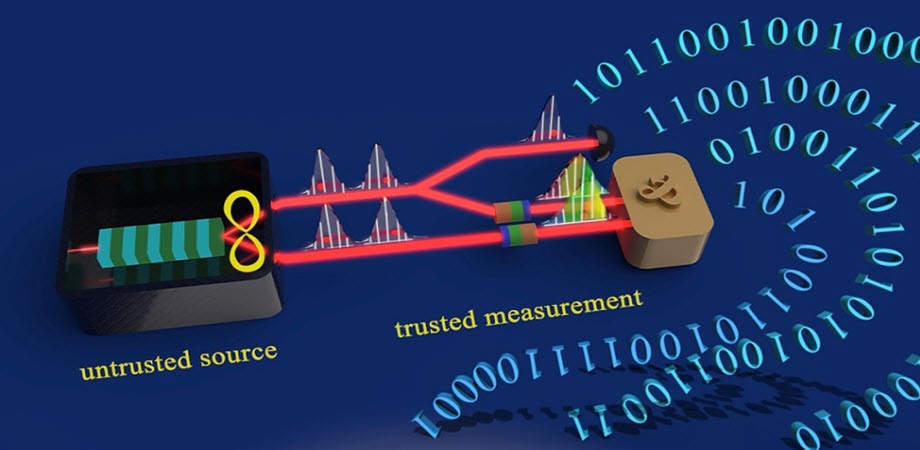
- Photon Polarization: A common method involves sending single photons through a beam splitter. A photon entering a 50/50 beam splitter has an equal probability of passing through or being reflected. The path it takes (which can be detected by sensors) determines a binary outcome (0 or 1). Since the photon's path is truly random, the resulting bit is also truly random.
- Quantum Noise from Diodes: The inherent noise (shot noise) generated by current flowing through a p-n junction diode (like those found in LEDs or photodiodes) is a quantum phenomenon. The fluctuations in electron flow are fundamentally random and can be amplified and converted into random bits.
- Vacuum Fluctuations: Some advanced QRNGs measure the quantum noise present even in a vacuum. By precisely measuring the electric field fluctuations of the quantum vacuum, a stream of random numbers can be extracted.
Each of these methods provides a unique physical mechanism for extracting true randomness directly from the quantum realm.
From Quantum Event to Digital Bit: The Process
The general process for a QRNG involves several steps:
- Quantum Source: A device generates the quantum event (e.g., a single photon source, a noisy diode, a vacuum chamber).
- Measurement Apparatus: Sensors measure the outcome of the quantum event (e.g., photon detectors, voltage meters).
- Analog-to-Digital Conversion: The analog signal from the measurement is converted into digital data.
- Post-Processing: Raw random bits often undergo a light post-processing step to remove any subtle biases introduced by the measurement apparatus itself, ensuring the output is truly uniformly distributed and uncorrelated. This is not to "make" them random, but to "purify" them.
The result is a stream of genuinely unpredictable, high-entropy random numbers ready for use in critical applications. For more technical insights, consider exploring resources on quantum random number generation technology.
The Unparalleled Advantages of Quantum-Derived Randomness
The fundamental difference in how QRNGs generate random numbers translates into significant advantages over classical methods, particularly in security-sensitive contexts.
Superior Unpredictability and Non-Determinism
The primary advantage of QRNGs is their inherent non-determinism. Unlike PRNGs, which are deterministic algorithms, the randomness generated by a QRNG stems from the probabilistic nature of quantum phenomena. This means the numbers produced are not just computationally difficult to predict; they are fundamentally impossible to predict, even with infinite computational power. This level of unpredictability is crucial for generating truly unique and secure cryptographic keys.
Enhanced Cryptographic Security
For applications like data encryption, secure key exchange, and digital signatures, the quality of random numbers is paramount. Weak or predictable random numbers can create critical vulnerabilities that attackers can exploit. QRNGs provide the strongest possible source of entropy, making cryptographic keys and other random elements practically unbreakable through prediction. This significantly boosts overall cybersecurity posture, protecting sensitive information from sophisticated attacks.
Future-Proofing Against Quantum Threats
The rise of quantum computing poses a significant threat to many of today's cryptographic algorithms, particularly those relying on the difficulty of factoring large numbers or solving discrete logarithms. While these algorithms are secure against classical computers, future fault-tolerant quantum computers could potentially break them. This concern has driven the development of post-quantum cryptography (PQC) – algorithms designed to be secure against both classical and quantum attacks. QRNGs play a vital role in this future-proof strategy by providing the truly random seeds and keys necessary for these new, more resilient algorithms. They are essential for generating the strong, unpredictable entropy required for quantum-safe algorithms.
Key Applications of Quantum Random Number Generators
The implications of truly random number generation extend across various sectors, enhancing security, fairness, and scientific accuracy.
Cybersecurity and Data Encryption
This is arguably the most critical application. QRNGs can be used to generate:
- Encryption Keys: Providing truly random, unpredictable keys for symmetric and asymmetric encryption, bolstering the security of encrypted data.
- Session Keys: Ensuring each communication session uses a unique, ephemeral, and strong random key.
- Digital Signatures: Enhancing the integrity and non-repudiation of digital transactions.
- Random Salts: Protecting passwords and hashes from rainbow table attacks by adding unique random values.
Integrating QRNGs into existing security infrastructure can significantly fortify defenses against even the most advanced threats. Explore how QRNGs can fortify your digital defenses.
Secure Communication Protocols
Protocols like TLS/SSL, VPNs, and secure messaging apps rely heavily on random numbers for key exchange and session management. QRNGs can be deployed in hardware security modules (HSMs) or dedicated devices to provide the highest level of randomness for these protocols, ensuring secure communication channels that are resistant to eavesdropping and tampering.
Scientific Research and Simulation
Many scientific fields, from physics and chemistry to finance and climate modeling, rely on Monte Carlo simulations that require vast amounts of high-quality random numbers. QRNGs can provide the unbiased, truly random inputs needed for more accurate and reliable simulation results, leading to better scientific insights and discoveries.
Gaming and Lotteries
Fairness is paramount in online gaming, lotteries, and gambling platforms. QRNGs can guarantee that outcomes are genuinely random and unpredictable, preventing manipulation and building trust with users. This ensures the integrity of game results and payouts.
Blockchain and Cryptocurrencies
The integrity of blockchain networks and cryptocurrencies depends on strong cryptographic primitives. QRNGs can be used to enhance the randomness in:
- Wallet Key Generation: Ensuring private keys are truly unpredictable.
- Proof-of-Stake Consensus: Providing random selection mechanisms for validators.
- Smart Contract Execution: Introducing true randomness into smart contract logic for applications like decentralized gaming or lotteries.
This adds an additional layer of security and trust to decentralized systems.
Integrating QRNGs: Practical Considerations and Future Outlook
While the benefits of QRNGs are clear, their practical implementation involves considerations regarding hardware, integration, and the evolving technological landscape.
Hardware vs. Software Implementations
QRNGs are inherently hardware-based because they rely on physical quantum phenomena. However, they can be accessed via software interfaces. Solutions range from:
- Dedicated Hardware Devices: Standalone QRNG devices that can be integrated into servers, network appliances, or security modules. These offer the highest performance and security.
- Cloud-Based Services: Some providers offer QRNG-as-a-Service, where users can access streams of quantum-generated random numbers over a network. This offers scalability and ease of access but introduces network latency and trust considerations.
- Integrated Chips: Smaller QRNG chips are beginning to be integrated directly into processors or specialized security hardware, making them more accessible for everyday devices.
The choice depends on the specific application's security requirements, performance needs, and budget.
Choosing the Right QRNG Solution
When considering the adoption of quantum random number generation technology, organizations should evaluate:
- Randomness Quality: Look for certifications and statistical tests (e.g., NIST SP 800-22) that validate the quality and unpredictability of the generated numbers.
- Throughput: How many random bits per second can the QRNG generate? This is crucial for high-demand applications.
- Integration Ease: Does the QRNG come with well-documented APIs and SDKs for seamless integration into existing systems?
- Physical Security: For hardware QRNGs, consider tamper resistance and physical safeguards.
- Cost-Effectiveness: Balance the security benefits against the investment required.
Consider integrating this cutting-edge technology to significantly enhance your system's security posture.
The Evolving Landscape of Quantum Technology
The field of quantum computing and quantum technologies is advancing rapidly. As quantum computers become more powerful, the need for robust, quantum-resistant security solutions, including QRNGs, will only intensify. Research continues to refine QRNG designs, making them smaller, more efficient, and more cost-effective. The synergy between QRNGs and other quantum technologies, such as quantum key distribution (QKD), promises an even more secure future for digital communications.
Frequently Asked Questions About Quantum Random Number Generators
What makes quantum randomness superior to classical randomness?
The superiority of quantum randomness stems from its fundamental nature. Classical randomness, even from physical sources like thermal noise, is ultimately deterministic if all underlying variables were known. Pseudorandom numbers are generated by algorithms and are inherently predictable. In contrast, quantum random number generators derive their output from truly probabilistic quantum phenomena like photon polarization or vacuum fluctuations, whose outcomes are intrinsically unpredictable and non-deterministic according to the laws of quantum mechanics. This makes quantum randomness the purest and most robust form of randomness available, ideal for critical security applications like cryptographic security.
Are Quantum Random Number Generators widely available today?
Yes, QRNGs are increasingly available, though perhaps not as ubiquitous as traditional hardware or software PRNGs. You can find them as dedicated hardware devices from specialized manufacturers, often integrated into network security appliances or hardware random number generators. There are also cloud-based services that provide access to quantum-generated random numbers via APIs. While still a niche market compared to conventional methods, their adoption is growing rapidly in sectors demanding the highest levels of security and unpredictability, such as government, finance, and advanced cybersecurity.
How do QRNGs contribute to post-quantum cryptography?
QRNGs are crucial for post-quantum cryptography (PQC) because PQC algorithms, while designed to resist quantum computer attacks, still require strong, unpredictable random numbers for key generation, signing, and other cryptographic primitives. If the random numbers used to generate PQC keys are weak or predictable, the entire system could be compromised, regardless of the PQC algorithm's strength. QRNGs provide the truly random, high-entropy seeds and inputs necessary to ensure that PQC implementations are as robust and secure as their underlying mathematical designs intend them to be. They are a foundational component for building quantum-safe algorithms and a truly quantum-resistant digital infrastructure.
What are the main challenges in deploying QRNG technology?
While powerful, QRNG deployment faces several challenges. Firstly, the hardware can be more complex and expensive than traditional PRNGs, requiring specialized components and precise calibration. Secondly, achieving very high bit rates (throughput) can be technically challenging and costly, though advancements are continually improving this. Thirdly, ensuring the integrity of the quantum source and preventing external interference is critical to maintaining true randomness. Finally, integrating QRNGs into existing legacy systems requires careful planning and often custom solutions. Despite these challenges, the increasing demand for superior cybersecurity and the looming threat of quantum computing are driving rapid innovation and adoption.

0 Komentar