
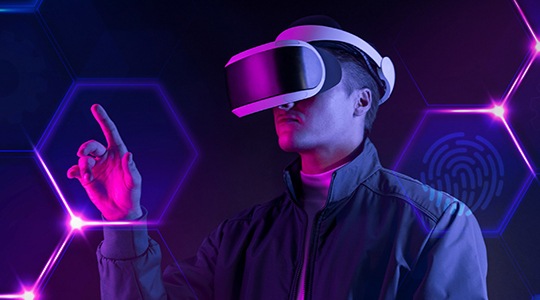
The Future of Virtual Reality in 2025: Unlocking Next-Gen Immersive Advancements
Prepare to step into a future where the lines between the physical and digital blur with unprecedented clarity. The year 2025 is poised to be a pivotal moment for virtual reality (VR) technology, transforming from a niche gaming accessory into a ubiquitous tool impacting every facet of our lives. This comprehensive guide delves into the groundbreaking advancements, key trends, and transformative applications that will define the future of virtual reality in 2025, offering a roadmap for businesses, developers, and enthusiasts keen to navigate this rapidly evolving landscape. We'll explore how next-gen hardware, sophisticated software, and evolving user expectations are converging to deliver truly immersive experiences that redefine interaction, learning, and entertainment.
The Current Landscape: Setting the Stage for VR's Evolution by 2025
Before peering into the crystal ball, it's essential to understand VR's present trajectory. Today, virtual reality is primarily recognized for its gaming prowess and initial forays into enterprise applications. Devices like Meta Quest and Valve Index have democratized access, making standalone and PC-tethered VR more accessible than ever. However, current limitations in resolution, field of view, haptic feedback, and overall user comfort still present significant hurdles for mass adoption. Yet, the rapid pace of innovation suggests these barriers are crumbling fast. The foundational work laid in the early 2020s in areas like spatial computing and improved optics is setting the stage for an explosive period of growth and maturity, directly influencing the VR technology trends we anticipate by 2025.
Key Technological Leaps Driving VR's Evolution by 2025
The advancements in virtual reality will not be incremental; they will be revolutionary, driven by significant breakthroughs in core technological components.
Untethered Freedom: The Rise of Standalone VR Headsets
By 2025, wireless VR will be the dominant form factor. The era of cumbersome cables will largely be relegated to highly specialized, high-fidelity professional setups. Standalone VR headsets will feature significantly more powerful, yet energy-efficient, chipsets, rivaling the processing power of dedicated gaming consoles. This allows for complex graphics rendering and sophisticated physics simulations directly on the device, without the need for an external PC.
- Enhanced Portability: Users will seamlessly transition between environments, from living rooms to public spaces, for their immersive experiences.
- Reduced Latency: Optimized internal pipelines will minimize motion-to-photon latency, significantly reducing motion sickness for many users.
- Improved Battery Life: Energy management innovations will extend usage times, making longer, uninterrupted sessions feasible.
- Wider Adoption: The ease of use and reduced setup complexity will be a major driver for increased consumer VR adoption.
Hyper-Realistic Visuals and Audio: Beyond Immersion
The visual fidelity in 2025 VR headsets will be astounding. Expect resolutions approaching or exceeding 4K per eye, coupled with wider fields of view (FOV) that minimize the "screen door effect" and enhance peripheral vision. Crucially, advancements in eye-tracking technology will enable foveated rendering, where only the area of the display the user is directly looking at is rendered in full resolution, drastically reducing computational load while maintaining visual sharpness. This is a game-changer for performance and realism.
Audio will be equally transformative. Advanced spatial audio, often integrated with head-tracking, will create truly convincing soundscapes that mimic real-world acoustics. This means being able to pinpoint the exact direction and distance of sounds, adding another profound layer to the immersive experiences.
Practical Advice: Developers should prioritize optimizing for foveated rendering and integrating high-quality spatial audio solutions to future-proof their content.
Haptic Feedback and Full-Body Tracking: Bridging the Physical-Digital Divide
The sense of touch is the next frontier for true immersion. By 2025, haptic feedback will move beyond simple controller vibrations. Expect to see the proliferation of advanced haptic gloves and suits that provide nuanced tactile sensations, allowing users to "feel" textures, temperatures, and resistance in virtual environments. This will be critical for realistic virtual training simulations and deeply engaging interactive experiences.
Concurrently, full-body tracking solutions will become more common and accurate, often integrated directly into the headset or via unobtrusive external sensors. This enables avatars to precisely mirror real-world movements, enhancing social presence in virtual spaces and enabling more intuitive interaction with virtual objects. Imagine conducting a virtual surgery where you not only see the instruments but feel the tissue resistance, or participating in a virtual dance class where your avatar perfectly replicates your every move.
AI Integration and Adaptive Environments
Artificial intelligence will seamlessly weave itself into VR experiences by 2025. AI will personalize content, dynamically adjust difficulty, and create more intelligent and reactive non-player characters (NPCs). Generative AI, for instance, could dynamically create vast, unique virtual worlds on the fly, or populate existing environments with adaptive challenges and narratives. This means every VR session could be unique, tailored to the individual user's preferences and performance, significantly enhancing replayability and engagement. AI will also play a role in optimizing performance and rendering for next-gen VR headsets.
Transformative Applications: Where VR Will Thrive in 2025
The impact of these technological advancements will ripple across numerous sectors, creating unprecedented opportunities and fundamentally changing how we work, learn, and play.
Enterprise and Industrial Virtual Reality Solutions
2025 will see a massive acceleration in the adoption of enterprise VR solutions. Businesses will leverage VR for everything from product design and prototyping to remote collaboration and complex machinery maintenance. For instance, architects can walk through virtual buildings before construction begins, engineers can collaboratively design 3D models in shared virtual spaces, and field technicians can receive real-time, augmented guidance overlaid on physical equipment. This reduces travel costs, accelerates design cycles, and significantly improves training efficacy.
- Virtual Training Simulations: Critical for high-stakes industries like aviation, defense, and manufacturing, providing safe, repeatable, and cost-effective training environments.
- Remote Collaboration: Immersive virtual meeting spaces will offer a sense of presence far beyond video conferencing, fostering stronger team dynamics for distributed workforces.
- Product Design & Visualization: Enabling rapid iteration and review of 3D models in a realistic, scalable environment.
Call to Action: Businesses should start exploring pilot programs for VR integration in their training and collaboration workflows to gain a competitive edge. Discover how Enterprise VR can revolutionize your business operations.
Healthcare and Medical Advancements Through VR
The healthcare sector is ripe for VR disruption. By 2025, healthcare VR applications will be commonplace for surgical training, pain management, physical therapy, and even mental health treatment. Surgeons will practice intricate procedures in high-fidelity virtual operating rooms, refining their skills without risk. Patients suffering from chronic pain or phobias will find relief through immersive therapeutic environments designed to distract or desensitize them. VR will also be used for medical education, allowing students to explore human anatomy in 3D with unparalleled detail.
Education and Skill Development: Learning in the Metaverse
The classroom of 2025 will extend into the virtual realm. Education VR platforms will offer truly immersive learning experiences, from historical reenactments that transport students to ancient civilizations to virtual laboratories where complex scientific experiments can be conducted safely. Practical skills, from welding to complex machinery operation, will be taught through realistic virtual training simulations, allowing for hands-on practice without the need for expensive physical equipment or dangerous environments. This democratizes access to high-quality, experiential learning.
Entertainment and Social Experiences: The New Digital Frontier
While gaming remains a strong driver, 2025 will see VR entertainment diversify significantly. Virtual concerts, interactive narratives, and deeply social virtual worlds will flourish. The concept of the metaverse development will gain significant traction, with persistent, interconnected virtual spaces becoming platforms for social interaction, commerce, and creative expression. Imagine attending a live concert where you can interact with other attendees and even the performers' avatars, or exploring a vast digital world built by a global community. The evolution of immersive experiences will redefine digital entertainment.
- Hyper-Realistic Gaming: VR games will offer unparalleled immersion, with advanced physics, AI, and detailed environments.
- Social VR Platforms: More sophisticated avatars, spatial audio, and shared activities will foster deeper connections in virtual social hubs.
- Virtual Events & Tourism: Attending global events or exploring exotic locations from the comfort of your home will become a high-fidelity reality.
- New Forms of Storytelling: Interactive VR films and experiences will allow audiences to influence narratives and inhabit character roles.
Overcoming Challenges and Ensuring Widespread Adoption
While the future looks bright, several challenges must be addressed for VR to truly reach its full potential by 2025. These include:
- Cost and Accessibility: While prices are trending downwards, next-gen hardware still needs to become more affordable for broader consumer VR adoption. Simplified interfaces and plug-and-play functionality will also be key.
- Content Creation Pipeline: Developing high-quality VR content is complex and resource-intensive. Tools and workflows need to become more streamlined and accessible to a wider range of creators.
- User Comfort and Ergonomics: Headsets must become lighter, more comfortable, and offer longer battery life to facilitate extended use without discomfort. Addressing motion sickness for sensitive individuals remains an ongoing challenge, though advancements like foveated rendering and lower latency are helping.
- Interoperability and Standards: For the metaverse concept to truly flourish, there needs to be greater interoperability between different platforms and content. Common standards for avatars, assets, and identity will be crucial.
- Data Privacy and Security: As VR becomes more integrated into our lives, concerns around personal data, biometrics, and virtual identity theft will need robust solutions.
Actionable Insights for Businesses and Developers
For those looking to capitalize on the impending VR revolution, proactive engagement is paramount.
- Invest in R&D and Talent: Companies should allocate resources to research and development in VR, and actively seek out talent with expertise in 3D development, spatial computing, and human-computer interaction.
- Pilot Programs and Proof-of-Concepts: Start small. Identify specific use cases within your organization or industry where VR can offer tangible benefits, then launch pilot programs to gather data and refine strategies.
- Focus on User Experience (UX): Regardless of the technical prowess, if the user experience is clunky or uncomfortable, adoption will falter. Prioritize intuitive interfaces, natural interactions, and ergonomic design.
- Collaborate and Partner: The VR ecosystem is vast. Collaborate with hardware manufacturers, software developers, and content creators to leverage existing expertise and accelerate your own VR initiatives.
- Educate and Evangelize: Many decision-makers still view VR as a novelty. Educate stakeholders on the real-world ROI and transformative potential of enterprise VR solutions.
- Prepare for the Metaverse: While a fully realized metaverse is beyond 2025, the foundational technologies and user behaviors are forming now. Consider how your brand or service could exist and thrive in persistent virtual spaces.
Frequently Asked Questions
What is the primary focus of VR advancements by 2025?
The primary focus of VR advancements by 2025 is on achieving unparalleled realism and accessibility. This involves significant leaps in visual fidelity (higher resolution, wider FOV, foveated rendering), enhanced sensory feedback (advanced haptic feedback and spatial audio), and the widespread adoption of powerful, comfortable wireless VR headsets. The goal is to make VR experiences indistinguishable from reality for many users, while simultaneously making the technology easier and more affordable to access for the general public.
How will haptic feedback enhance VR experiences?
Haptic feedback will dramatically enhance immersive experiences in VR by enabling users to feel virtual objects and interactions. By 2025, this will move beyond simple vibrations to include nuanced sensations like texture, temperature, and resistance. This allows for more realistic virtual training simulations, where a trainee can feel the pressure of a virtual tool, or for gaming, where players can feel the impact of a virtual punch or the texture of a virtual surface. It bridges the gap between sight and touch, making virtual worlds feel truly tangible.
What industries will see the most significant impact from enterprise VR solutions?
By 2025, industries poised for the most significant impact from enterprise VR solutions include manufacturing, healthcare, education, architecture, engineering, and remote collaboration. Manufacturing will leverage VR for design, prototyping, and assembly line training. Healthcare will utilize it for surgical training, therapy, and pain management. Education will adopt education VR platforms for immersive learning and practical skill development. Architecture and engineering will use VR for design reviews and client presentations. Finally, remote collaboration will be transformed by immersive virtual meeting spaces that foster stronger presence and interaction among distributed teams.
Will VR become affordable for the average consumer by 2025?
Yes, while high-end professional VR systems will remain a premium, consumer VR adoption will be significantly driven by increasingly affordable and powerful standalone headsets by 2025. Major tech companies are heavily investing in bringing down costs while simultaneously boosting performance and comfort. Expect a tiered market with accessible entry-level devices offering great experiences, alongside more advanced options for enthusiasts. The trend towards integrated, all-in-one solutions will eliminate the need for expensive external hardware, making VR a much more viable purchase for the average consumer.

0 Komentar